







A successful feasibility study should leave no stone unturned and draw on technical, commercial and financial knowledge to derive the optimum solution whilst assessing risk and considering suitable mitigation and contingencies.
We deliver detailed feasibility assessments for low-carbon energy projects, supporting both the decarbonisation of existing buildings and networks and the design of new low-carbon plant or proposed district energy networks.
As part of our feasibility approach, we evaluate a wide range of heat sources, technologies, and network routing options and develop a long list of potential solutions that is then narrowed down to a practical short list. This allows clear comparison of technical, financial, and carbon impacts of the shortlisted options to identify the optimal solution for each project. Our assessments provide clients with the insight needed to make confident, evidence-based decisions and de-risk low-carbon investment.
Ready to move forward?

Techno-economic modelling
A successful techno-economic model is one that stands the test of time, and allows all foreseeable scenarios and circumstances to be updated and tested within the model, as projects develop.
We provide advanced techno-economic modelling to evaluate and compare low-carbon energy solutions, helping clients make informed decisions based on both economic performance and carbon impact.
Our models allow detailed assessment of different technical options, network layouts, and heat demand phasing, allowing comparison of financial indicators such as IRR, NPV, social IRR, and the carbon intensity of energy delivered for different solutions.
Our models allow key parameters including energy costs, heat and electricity sale tariffs, and potential grant funding to be varied to understand their impact on project economics and performance. This enables a clear comparison of alternative solutions, allowing the selection of the solution that best meets the client's objectives.

Concept designs
The visualisation of system layouts and requirements breathes life into early stage projects and helps to de-risk, inform costs and phasing decisions, and engage with stakeholders.
At the feasibility stage, we develop concept designs to provide a clear understanding of the spatial, technical, and planning requirements for low-carbon energy projects. This can include RIBA Stage 2-level designs for energy centres, plant rooms, and heating substations, including the balance of plant and integration with existing building systems.
Our designs identify the space required for equipment, assess potential locations for energy centres or substations, and highlight planning or regulatory constraints that could affect project delivery. We also consider operational access, safety, and integration with existing infrastructure, providing an early view of technical feasibility and potential modifications.

Heat network routing & sizing
Network routing and sizing should be optimised to find the best balance between capital cost, operational efficiency, and future growth, taking into account current and future energy demands, seasonal variations, and the potential for phased expansion of the network.
We provide expert services in the routing, design, and sizing of district heating networks, ensuring efficient, low-carbon heat delivery. Our approach begins with detailed analysis of heat demand, building locations, and existing infrastructure, allowing us to identify the most effective network layout. We consider factors such as proximity to heat sources, major heat users, topography, and physical constraints including roads, rivers, and existing utilities.
Pipe sizing, pressure drop, and flow calculations are carefully assessed to ensure reliable performance while minimising energy losses.

Surveys and investigations
The best plans are built on a detailed knowledge of the environment; being clear and diligent about the information required at each stage of project development is essential.
We carry out comprehensive site surveys to support single-building decarbonisation and connection to district heating networks. For individual buildings, surveys assess available space for low-carbon plant, such as rooftop or external heat pump installations, and review existing heating systems for compatibility with the typically lower-temperature heat supply from heat pumps.
We identify necessary upgrades, including plant-room modifications, secondary-side improvements, or replacement of heat emitters to allow the heat pumps to work at maximum efficiency.
For buildings connecting to networks, we evaluate space for heating substations, assess whether existing plant needs to be removed, and check secondary-side system compatibility. In residential buildings, this may involve replacing individual boilers and hot water tanks with HIUs, heat meters, and potentially new radiators.
Surveys also examine potential energy centre locations – ideally close to heat sources like mine water, EfW, or data centres – and major heat users. Network route options are assessed for constraints such as roads, rivers, and existing infrastructure, ensuring practical, low-carbon heat delivery.
Powering the civic core: Bradford’s city centre heat network
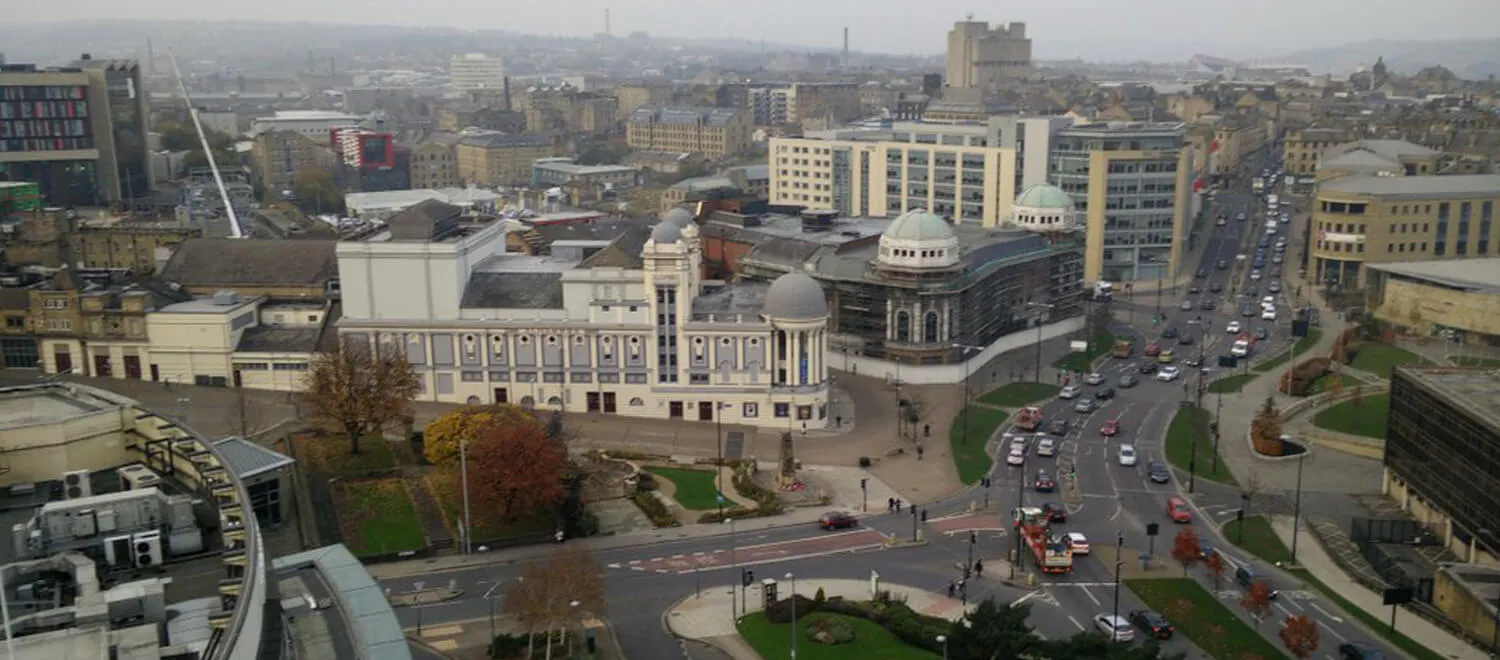
Bradford MDC engaged us to review existing heat mapping work and develop a detailed feasibility study and full design for a city centre district energy network serving public sector buildings and nearby businesses.