








At the detailed project development stage, we guide clients through every step needed to turn a low-carbon energy concept into an investable project.
We prepare full Outline Business Cases across all five Green Book areas and develop detailed techno-financial models to test viability, pricing, and demand. We help define delivery models, contractual structures, and risk allocation, working closely with commercial, financial, legal, and client teams to make sure everything is consistent and connected. We advise on governance and project management, identify and mitigate risks, assess demand, and produce clear delivery programmes to keep the project on track and investment-ready.
Ready to move forward?

Commercialistion strategy
Finding the right commercial route to deliver a project requires independence and experience in navigating the full development journey via all types of commercial models.
We help clients define the most suitable commercialisation approach for their heat network, considering a range of public and private sector options, including own-and-operate models, concessions, joint development agreements, and golden share arrangements.
For golden share arrangements, clients can retain influence over key areas such as residential heat tariffs, while contributing to the network, for example, by providing land for energy centres, balancing control, affordability, and delivery risk. We review the pros and cons of each option alongside our clients’ risk and investment appetite to identify the optimal commercialisation approach. This also considers how securing grant funding can strengthen engagement.
Once a commercialisation approach is selected, we develop the design and undertake technical de-risking to a level appropriate for that approach and determine the most effective procurement route.

Concept designs
The visualisation of system layouts and requirements breathes life into early stage projects and helps to de-risk, inform costs and phasing decisions, and engage with stakeholders.
At the feasibility stage, we develop concept designs to provide a clear understanding of the spatial, technical, and planning requirements for low-carbon energy projects. This can include RIBA Stage 2-level designs for energy centres, plant rooms, and heating substations, including the balance of plant and integration with existing building systems.
Our designs identify the space required for equipment, assess potential locations for energy centres or substations, and highlight planning or regulatory constraints that could affect project delivery. We also consider operational access, safety, and integration with existing infrastructure, providing an early view of technical feasibility and potential modifications.

Outline business case
A clear and concise business case will ensure each element informs the next, provide a cohesive, transparent framework that supports investment decisions and demonstrate that the project is well-planned, strategically aligned, and ready to progress.
We develop Outline Business Cases that provide a clear, evidence-based justification for low-carbon energy projects, helping clients move from concept to investible proposition. Working closely with internal teams and commercial, financial, and legal advisors – appointed by the client or us – we make sure all five cases are consistent, interconnected, and support one another.
We help clients shape the strategic case so it reflects both organisational priorities and wider targets, from city-wide ambitions to UK-wide policy objectives. Our approach integrates robust financial and economic analysis, risk management, and governance planning, giving decision-makers a clear picture of project viability and potential outcomes.

Financial modelling
To identify a truly viable project, energy concepts and technical assessment must be underpinned by a robust financial model that considers the investment criteria and hurdle rates of the client or other potential project developers.
Future energy demands and costs can be difficult to predict, so a robust model to support the business case is essential before proceeding to the next project stage.
We provide detailed financial assessments and models to support our business cases and technical designs. Our models draw on extensive, real-world experience to provide financial projections, assessments of multiple scenarios, and asset management strategies and sensitivity analyses to understand the impact of changes.
Sustainable Energy works with energy companies, special purpose vehicles, and local authorities to develop and maintain financial models. We ensure information is aligned and consistent between the economic, financial and business cases. Our models are clear and open for our partners and allow for life-cycle cost and income projections, financial planning, sensitivity analyses, energy market impact assessments and fuel source and supply chains to be kept up to date.
We create a comprehensive financial model during concept development, which will assess the economic viability of different technical solutions. We can produce budgetary capital and operating costs, enabling each option to be assessed against our client’s goals and ambitions. We can also assist in applying for any applicable funding to facilitate the project.

Funding and grant applications
There are numerous grants, incentives and assistance schemes across the UK for low-carbon and heat network projects. While this supports project development, the application and accreditation processes can be lengthy and daunting.
We have helped hundreds of clients to identify and secure funding for renewable energy and district heat network projects. We have submitted a number of successful HNIP, Green Heat Network Fund (GHNF), Scottish Heat Network Fund (SHNF) applications for heat network capital grants, as well as numerous successful application for the Public Sector Decarbonisation Scheme (PSDS) and the Heat Network Efficiency Scheme (HNES) for the upgrade and expansion of existing heat networks and Wales’ Local Authority Heat Decarbonisation Grant.
Sustainable Energy has been directly responsible for the accreditation of more than 200 renewable energy schemes for a range of government financial incentives, with installations ranging from 50kW to 20MW, including multimegawatt water source heat pumps, large-scale biomass heat and CHP, biogas plants and biomethane projects.
Our funding services include identifying suitable funding schemes, developing the funding case, completing the application process and developing all supporting documentation and ongoing grant claim submission and reporting.
Rooted in the estate: West Dean’s self-sufficient heat network
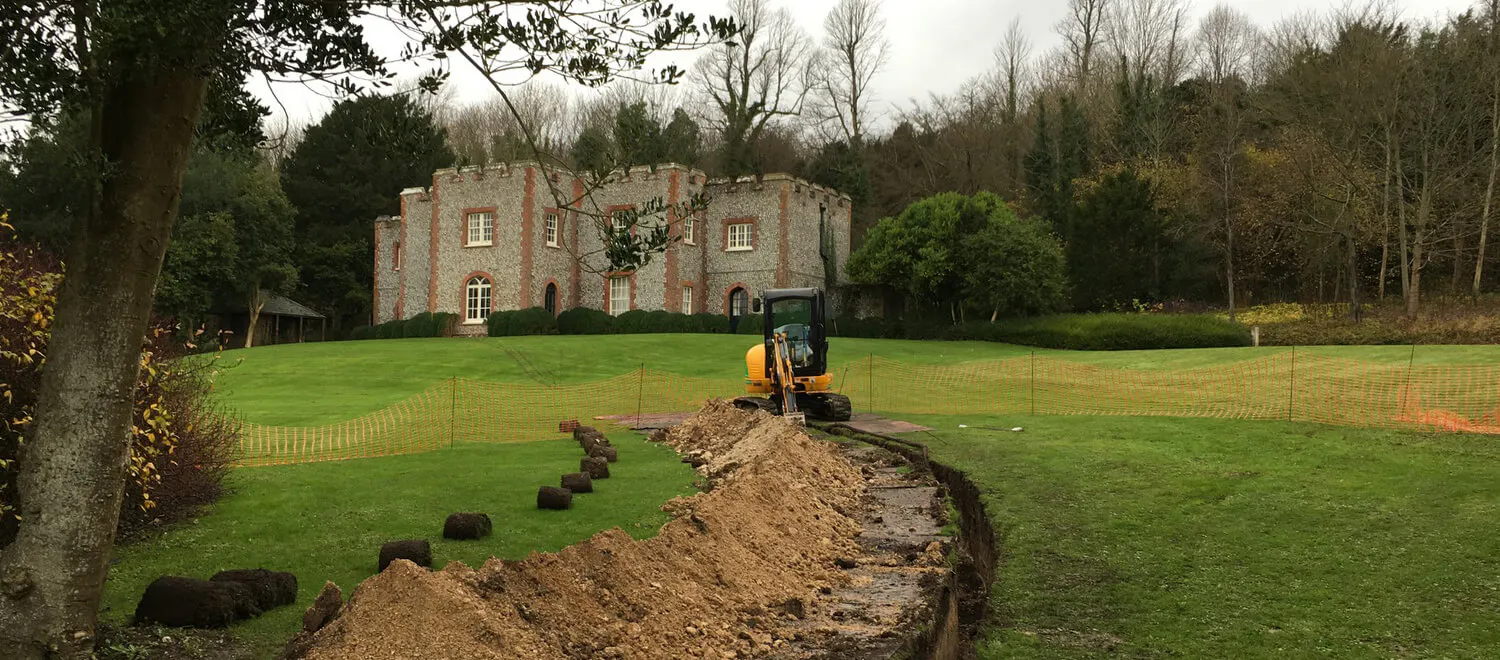
The Edward James Foundation is a registered charity encompassing West Dean College - which attracts arts and conservation students from across the UK and internationally - the award-winning West Dean Gardens, West Dean Tapestry Studios, and the wider 6,400-acre West Dean Estate.