







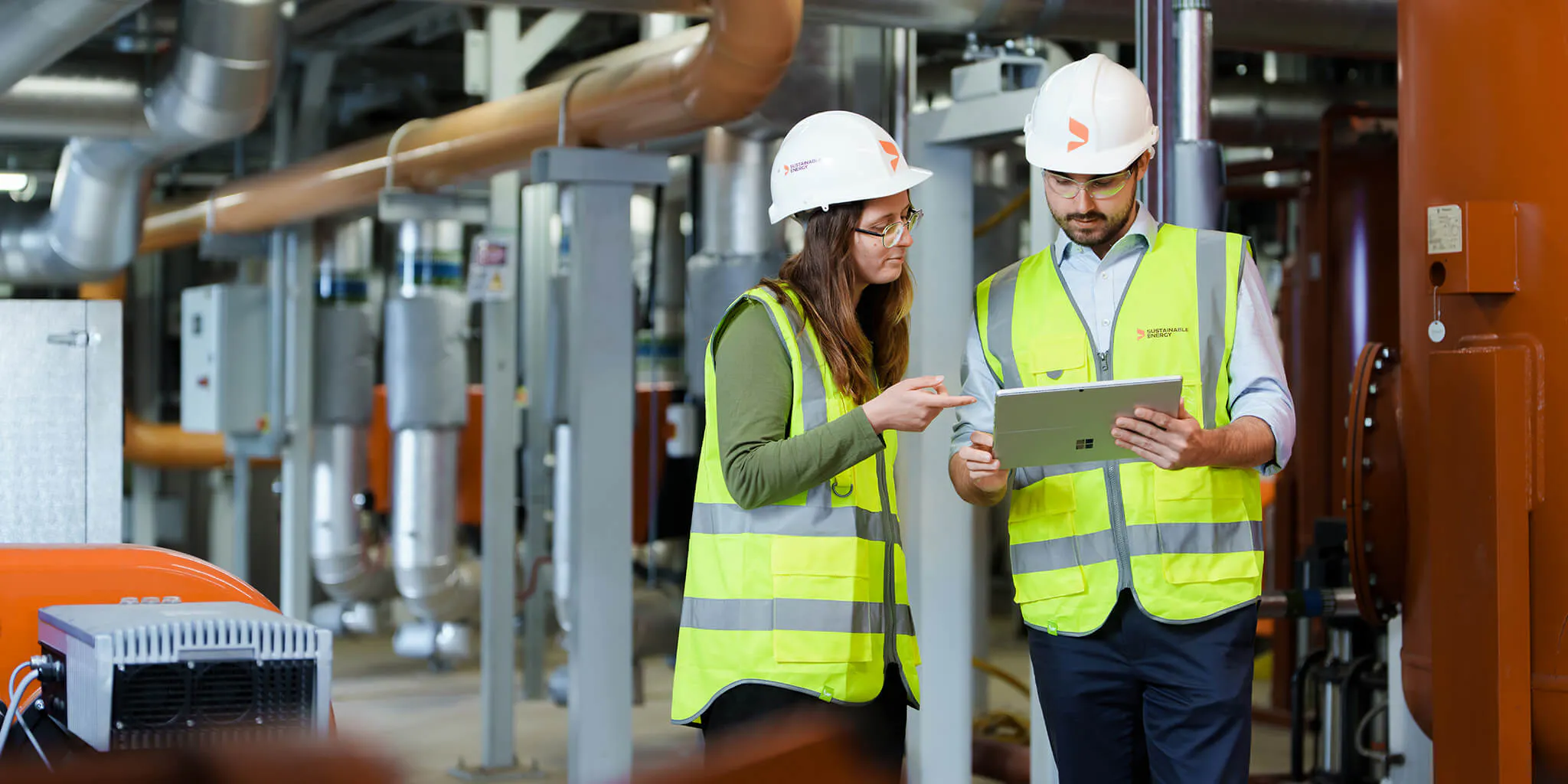
Best practice mechanical and electrical design is the key for energy systems to achieve reliable and safe operation, safety, technical compliance, innovation, sustainability, cost-effectiveness, and overall project success.
We have a strong engineering design team with expertise in mechanical, electrical and civil capabilities. We design energy systems, energy centres, heating and cooling plant, building services, utilities, control systems and post-installation monitoring systems. We design systems for single buildings and whole energy networks.
Ready to move forward?

Energy centre design
Designing energy centres for heat networks demands a careful balance of performance, resilience, and practicality. We develop low-carbon plant strategies supported by reliable backup systems, integrating multiple heat sources where appropriate to optimise efficiency and security of supply. Our designs prioritise low-temperature operation to maximise the performance of technologies such as heat pumps, while allowing for future network expansion and evolving regulatory compliance. We apply rigorous value engineering to minimise cost without compromising quality. With extensive experience of constrained sites—including existing plant rooms and locations co-sited with heat sources such as energy-from-waste or water treatment facilities—we deliver coordinated RIBA Stage 2–4 mechanical and electrical designs, alongside detailed specifications for the energy centre building and its systems.

Plant room design
Plant room design for site-level heat decarbonisation often involves the careful transformation of existing spaces. We assess current systems and develop strategies for selective strip-out, retention, and integration of plant, enabling low-carbon technologies such as heat pumps to be introduced alongside retained assets where appropriate. Where space is constrained, we explore solutions such as modular plant configurations and external thermal storage to optimise performance within tight footprints. Our approach maximises available space while improving efficiency, resilience, and operability, with systems designed for low-temperature operation and compatibility with existing infrastructure. We deliver coordinated RIBA Stage 2–4 mechanical and electrical designs, supporting low-disruption retrofit and futureproofed heat systems.

Communal systems design
Communal heating systems for residential blocks require a whole-system approach, combining plant room upgrades with careful redesign of building-wide distribution networks. We deliver retrofit and new-build solutions where low-carbon plant such as heat pumps are integrated with existing or upgraded infrastructure, often including full or partial strip-out of legacy systems. This extends to risers, laterals, and in-flat tertiary systems, typically incorporating HIUs for space heating and hot water. Our designs minimise pipe runs to reduce heat losses and disruption to residents, while enabling phased installation to maintain live services wherever possible. We optimise systems for low-temperature operation, often requiring pipework resizing and low-temperature emitters, and ensure compliant heat metering strategies aligned with current regulations and future requirements. We provide coordinated RIBA Stage 2–4 mechanical and electrical design, supporting seamless delivery from concept through detailed construction.

Controls and BMS design
We design integrated controls and BMS strategies that define the full operational functionality of heat networks and building systems. This includes specifying all required inputs, outputs, sequencing, and interlocks to ensure efficient, safe, and resilient operation of low-carbon plant, with flexibility built in for future expansion and system growth. Control strategies are developed to prioritise low-carbon plant wherever possible to minimise carbon intensity, while ensuring seamless and reliable operation of any backup plant when required. We develop detailed specifications for physical control equipment alongside a functional controls philosophy that sets out how all plant should operate under varying conditions. Our approach also covers data architecture, including collection, storage, and reporting requirements to support regulatory compliance, performance monitoring, and ongoing efficiency optimisation of the system.

LV and HV design
We design LV and HV electrical systems to support the transition to low-carbon heating, including high-capacity heat pumps and associated plant. This includes assessing site electrical demand, defining future load growth, and identifying capacity requirements for new grid connections. We manage the end-to-end application process for HV connections and coordinate with DNOs/IDNOs to secure supply. Our design scope covers HV infrastructure, transformers, and LV distribution systems, ensuring safe, resilient, and efficient power delivery to all plant. We also integrate auxiliary electrical requirements including small power, standby systems, and controls, with careful consideration of redundancy, operational flexibility, and future expansion of the heat network.

RIBA and BSRIA design stages
We work across the full RIBA Plan of Work and BSRIA design stages, supporting projects from early concept development through to detailed technical design (RIBA Stages 2–4). At these stages, we define system performance requirements, develop coordinated mechanical, electrical and controls designs, and ensure the solution is robust, buildable, and aligned with project objectives. Beyond design, we continue to support clients through construction and delivery (RIBA Stages 5–6) acting as client engineer, reviewing contractor installation, witnessing commissioning, and verifying that systems are delivered in line with the design intent. At handover (Stage 7), we assist with performance validation and post-occupancy review, ensuring systems operate efficiently in practice and providing insight to optimise long-term operation and carbon performance.
Building connection design
Building connection design for heat networks involves carefully integrating low-carbon heat supplies from the network into building systems. For existing buildings, we assess plant room space and suitability for accommodating a thermal substation, and develop a detailed understanding of current space heating and hot water distribution arrangements. Connections often require upgrades to existing heating systems to operate effectively at the lower temperatures supplied by heat networks, including modifications to distribution pipework and heat emitters where necessary. In all cases, we design practical, buildable solutions that enable a smooth transition to low-carbon heat which minimises disruption to occupants.
Aquifer source heat pump | Greenwich
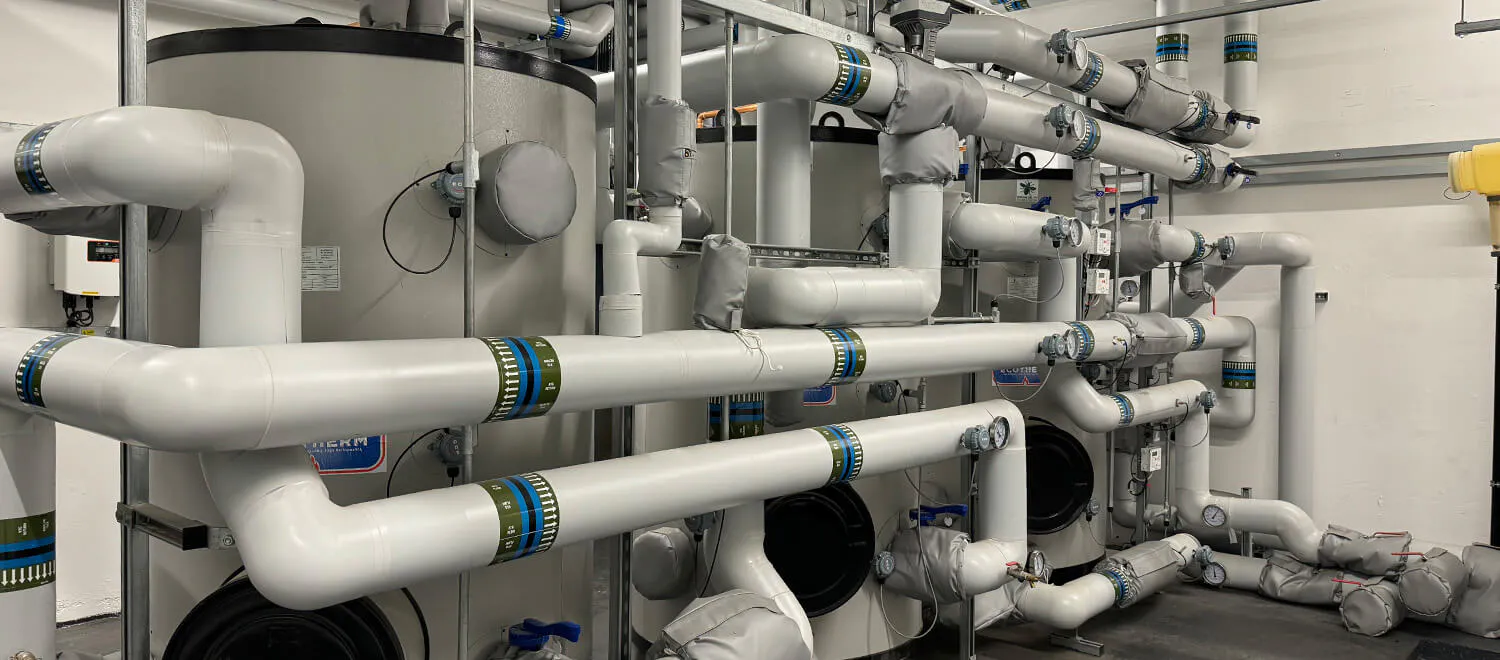
Sustainable Energy have completed a project for the Royal Borough of Greenwich (RBG) Council – a solution comprising an aquifer source heat pump, smart controls and flat heating design. This project is supported by Sharing Cities, an EU Horizon 2020 Smart Cities and Communities Programme, bringing together 30 partner organisations in 6 countries, and seeking to apply a ‘digital first’ approach to the areas of energy and transport in the three lead cities of London, Lisbon and Milan.