







/-2.5857616028479886,51.45449729920119,6,0/500x500@2x?access_token=pk.eyJ1IjoibGltZWdyZWVudGFuZ2VyaW5lIiwiYSI6ImNtbHA0NmozZzAwdDgzaHM5MW8zaWs2eWIifQ.jPG-FfO-fBhkFOFoh2gMDQ)
We worked with Bristol City Council, Bristol Heat Networks Ltd, and Vattenfall to develop a city-wide strategy for developing and connecting the local area heat networks across the city.
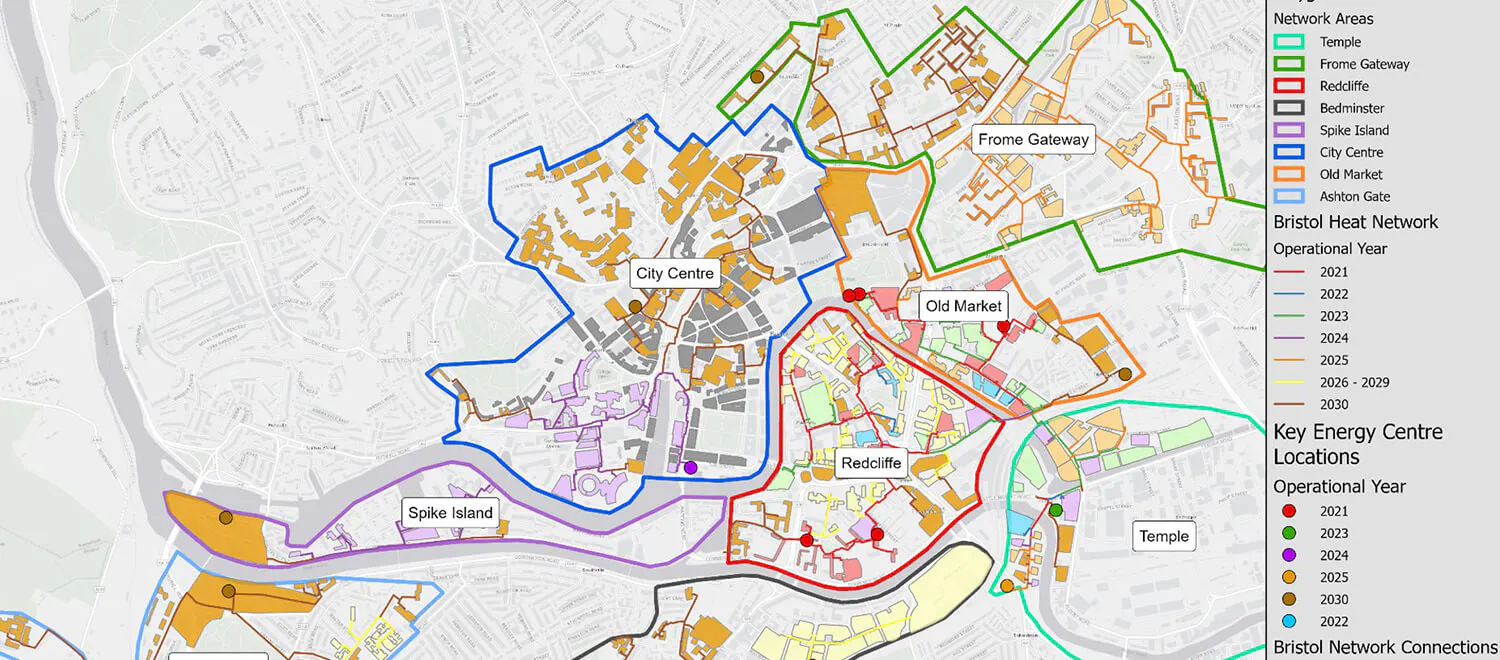
Beginning with feasibility and techno-economic studies across eight heat network areas, we developed a phased city-wide masterplan and strategic assessment that gave Bristol City Council and Vattenfall a clear, costed route to a carbon-neutral district energy system.
By using a dynamic heat network model we simulated the hourly demands of how over 800 buildings would draw heat from the city network. This complex model using FluidIT Heat is one of the most complex heat network models developed in the UK and was able to provide some key insights into how placing key energy centres and buried district heat infrastructure can deliver low carbon heat in a phased and deliverable approach.
Scope
Following several years working as lead technical advisor to Bristol City Council we were appointed by Vattenfall to undertake a strategic assessment of eight existing heat network areas across Bristol, reviewing previous studies and evaluating the potential to connect individual networks into a single city-wide system. This included network routing, sizing and costing, assessment of river and railway crossing constraints, identification of key energy centre sites, and development of a phased masterplan for the Bristol Heat Network. Building on this, we developed an extensive GIS library of heat demands, supply opportunities and network constraints, and evaluated the CO2e intensity trajectory of all existing and planned networks - making strategic recommendations to ensure the overall network remains on track for carbon neutrality by 2050.
Services
Feasibility, Heat Mapping & GIS, Techno-Economic Modelling, Detailed Design, Carbon Intensity Assessment
Solution
We used FluidIT Heat model to simulate a Bristol city wide heat network and developed an extensive GIS library of heat demands, supply opportunities, and network constraints to underpin a phased city-wide masterplan, identifying critical capacity thresholds and future energy centre locations. Carbon intensity trajectories were evaluated across all network areas to ensure the combined network remains below business-as-usual ASHP benchmarks on the path to carbon neutrality by 2050 - providing both Vattenfall and Bristol City Council with a route to full city-wide network delivery.